
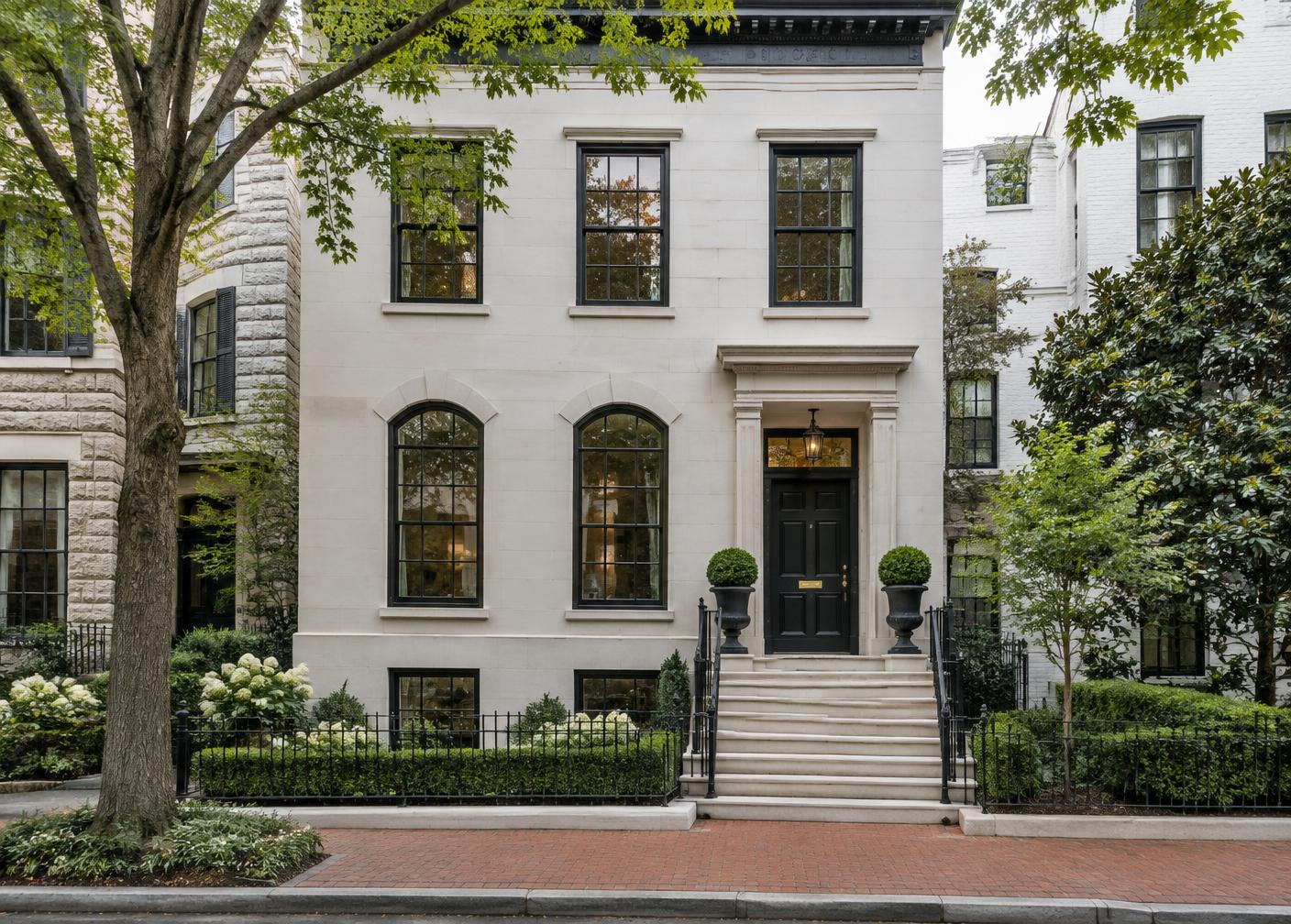
Limestone, brick and slate: reading a Georgetown façade
Before you step inside, the street has already told you most of the story.
By The SOL & MAISON Advisors · November 25, 2026 · 3 min read
Walk any block of Georgetown slowly and the houses begin to speak. Not loudly, and not all at once, but in the quiet details that most people pass without noticing: the rhythm of the brickwork, the weight of a stone lintel, the pitch and color of a slate roof. Learn to read those details and a façade becomes a record of when a house was built, how it was cared for, and what it might ask of its next owner.
Start with the brick
Georgetown was a working river port long before it became part of the capital, and much of what survives on its oldest streets is brick. Look at the pattern the bricks make. In Flemish bond, each course alternates the long face of a brick with its short end, giving the wall a fine, woven texture. It is a pattern associated with the late eighteenth and early nineteenth centuries, and with builders who expected a wall to be looked at closely. Later walls often switch to running bond, where only the long faces show. Neither is better; each simply belongs to its moment.
Then look at the mortar. Old lime mortar is soft by design, meant to give way before the brick does. Hard modern cement used in a careless repair can trap moisture and damage the brick around it. A wall with clean, recessed joints in a mortar that matches the original in color and texture usually belongs to an owner who took advice before picking up a trowel.
The weight of stone
Stone in a Georgetown façade is rarely decorative for its own sake. It carries load and sheds water. Limestone and sandstone appear as lintels over windows, as sills, and as the steps that lift a front door above the street. Look at the edges. Crisp arrises and even weathering suggest stone that has been maintained; spalling, cracks running into the brick, or a heavy coat of paint can point to work that will need attention. None of this is a reason to walk away from a house. It is simply part of knowing what you are buying.
Windows, doors and the line of the roof
Windows set the proportions of a façade. Count the panes, notice whether the glass has the faint ripple of older cylinder glass, and see whether the openings line up from floor to floor. Doors and their surrounds, from simple transoms to fanlights, are often where a builder chose to spend.
At the top, the roof finishes the sentence. Slate, with its gray and green tones and its long working life, is the material many of these houses were built to carry. A roof is one of the few parts of a house that is expensive to get wrong, so its condition belongs on every early list of questions.
What the rules protect
Much of Georgetown sits within a historic district, and changes to the outside of a building are reviewed before they happen. Buyers sometimes see this as a constraint. It is better understood as a promise: the street you fall in love with is likely to look much the same in twenty years, because every owner on it has agreed to look after the part of their house that faces the public. A façade is the one part of a house that belongs, in a sense, to everyone who walks past it.
“A facade is the one part of a house that belongs, in a sense, to everyone who walks past it.”
If you are considering a change to an exterior, ask early what review it will need, and build that time into your plans.
Reading as a habit
None of this replaces an inspection, a conversation with a preservation-minded contractor, or the counsel of an advisor who knows the neighborhood. But reading a façade changes how you walk a street. You start to notice which houses have been loved carefully, which have been changed in a hurry, and which are waiting for someone patient. In Georgetown, the street is always the first room of the house.
Newsletter
The Letter
One email a month with the month's Journal. No noise.